
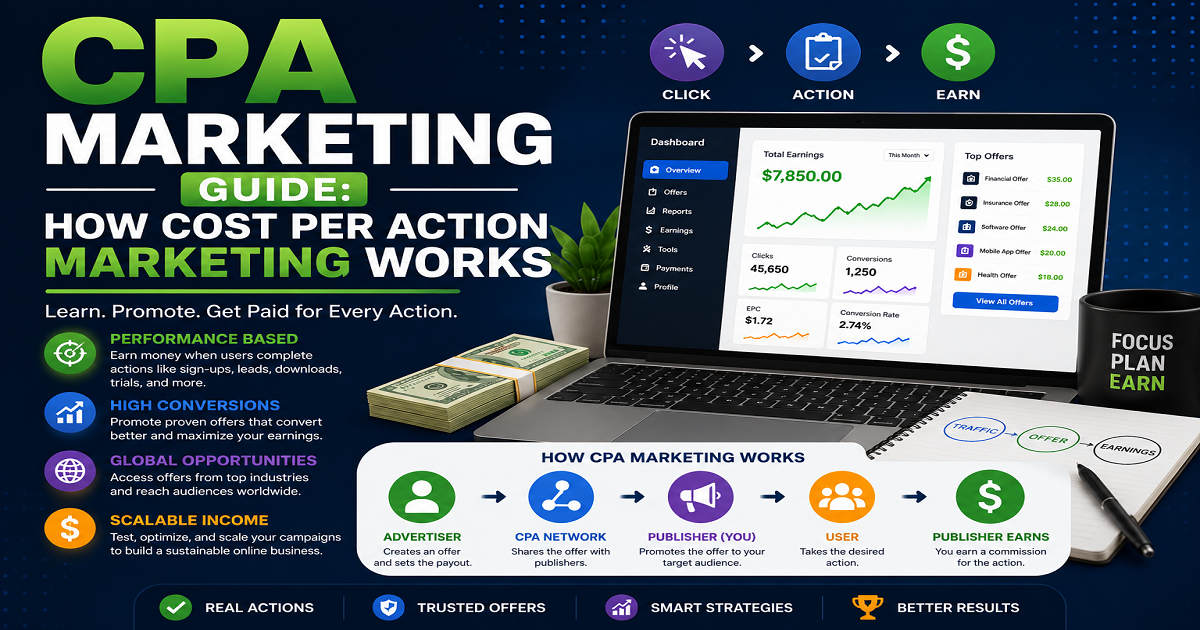
CPA Marketing Guide: How Cost Per Action Marketing Works
Discover how CPA marketing guide operates, find CPA networks and offers, investigate tried-and-true tactics, and discover how to begin Cost Per Action marketing as a novice.
One of the most widely used performance-based marketing strategies in the digital advertising sector is cost-per-action marketing, or CPA marketing. By advertising goods, services, or deals and encouraging particular activities from their audience, it enables marketers and affiliates to earn commissions.
CPA marketing compensates marketers when a visitor completes a predetermined action, in contrast to traditional advertising models that could concentrate on impressions or clicks. That action could be completing a lead form, registering for a service, downloading an application, beginning a free trial, or making a purchase, depending on the campaign.
Building a long-lasting online marketing strategy requires an understanding of CPA marketing, which is crucial for both novice and seasoned affiliate marketers.
CPA Marketing: What Is It?
Cost Per Action is referred to as CPA. When a user completes a certain action, an advertiser pays a marketer or affiliate under this performance-based advertising model.
The advertiser’s campaign determines the course of action. Typical CPA activities consist of:
Finishing the registration process
Filling out a lead form
Registering for a complimentary trial
Downloading a program or application
Asking for a quote
Getting a service subscription
Purchasing anything online
The marketer is not required to develop the product or manage customer fulfillment in a typical CPA campaign. Rather, the marketer concentrates on drawing in relevant visitors and motivating them to take the necessary action.
How Does CPA Marketing Guide Work?
Several important players are involved in the CPA marketing process:
Audience → Conversion → Affiliate → CPA Network → Advertizer
The advertiser decides on the desired conversion and develops a campaign.
When utilized, the CPA network offers tracking and reporting tools and links affiliates and advertisers.
A targeted audience is reached by the affiliate marketer, who selects appropriate offerings.
The customer completes the necessary step after interacting with the affiliate’s promotional content.
The affiliate gets paid the agreed-upon commission if the action is successfully tracked and approved.
What Is a CPA Network?
A CPA network is a platform that connects advertisers with affiliate marketers. It can provide access to multiple campaigns while handling important functions such as tracking, reporting, offer management, and affiliate payments.
CPA networks may contain offers from a wide variety of industries, including:
- Software and technology
- E-commerce
- Finance
- Education
- Mobile applications
- Online services
- Insurance
- Gaming
- Business services
Before joining or promoting an offer, marketers should carefully review the network’s policies and the specific campaign requirements.
Types of CPA Offers
CPA offers can vary significantly depending on the action required from the user.
Lead Generation Offers
Lead-generation campaigns typically require a visitor to provide information through a form. Examples can include quote requests, registrations, or inquiries.
App Install Offers
These campaigns reward affiliates when users download and install a specified mobile application.
Free Trial Offers
A user may need to register for a free trial of a product or service for the affiliate to receive a commission.
Registration Offers
Some campaigns pay affiliates when a visitor creates an account or completes a registration process.
Purchase-Based Offers
In some campaigns, the required action is a completed purchase. These offers are closely related to traditional affiliate marketing.
Benefits of CPA Marketing Guide
CPA Marketing offers several advantages for digital marketers.
Performance-Based Model
One of the biggest advantages of CPA Marketing is that earnings are connected to measurable user actions. This makes it easier to evaluate the performance of a marketing campaign.
No Need to Create Your Own Product
Affiliate marketers can promote existing products and services instead of developing, storing, or shipping their own products.
Multiple Marketing Channels
Depending on the offer’s terms, marketers may use channels such as SEO, blogs, social media, email marketing, content marketing, and paid advertising.
Wide Range of Niches
CPA campaigns are available across many industries, making it possible to find offers that align with different audiences and content strategies.
Best CPA Marketing Strategies
Choosing an offer is only the beginning. A successful CPA Marketing guide strategy requires relevant traffic, useful content, testing, and optimization.
1. Select a Profitable Niche
Choose a niche with an identifiable audience and enough demand for useful content. Technology, software, education, finance, online services, and e-commerce are examples of areas where affiliate opportunities may exist.
However, profitability should not be the only consideration. Your knowledge of the niche and ability to create valuable content are equally important.
2. Choose Relevant CPA Offers
An offer should match the interests and needs of your audience.
Consider factors such as:
- Commission structure
- Conversion requirements
- Target countries
- Allowed traffic sources
- Campaign restrictions
- Landing-page quality
- Advertiser reputation
Promoting an offer simply because it has a high payout can lead to poor results if it does not match your audience.
3. Create High-Quality SEO Content
SEO and CPA Marketing can work together effectively when content is created around genuine search intent.
Consider publishing:
- Detailed product reviews
- Product comparisons
- How-to tutorials
- Beginner guides
- Frequently asked questions
- Industry resources
- Problem-solving articles
Your primary goal should be to answer the reader’s question and provide useful information. Affiliate promotions should naturally support the content rather than overwhelm it.
4. Build Targeted Traffic
Traffic quality is often more important than traffic volume. A smaller audience that is genuinely interested in an offer may generate better conversions than a large audience with little relevance.
Potential traffic sources include:
- Search engine traffic
- Social media
- Email marketing
- Content marketing
- Online communities
- Paid advertising
Always follow the rules of the CPA network, advertising platform, and applicable laws.
5. Test and Optimize
Successful affiliate marketers rarely rely on a single strategy. Testing different headlines, content formats, calls to action, landing pages, and traffic sources can help identify what works best.
Use reliable tracking data to make decisions rather than relying on assumptions.
CPA Marketing and SEO
SEO for CPA Marketing can be a powerful long-term strategy because search engines can send targeted visitors to helpful content.
A strong CPA SEO strategy should include:
Keyword Research: Identify relevant keywords based on what your target audience is searching for.
Search Intent: Understand whether the visitor wants information, a comparison, a solution, or a product.
Helpful Content: Create original content that thoroughly addresses the user’s needs.
On-Page SEO: Optimize titles, headings, URLs, internal links, and relevant metadata naturally.
Internal Linking: Connect related articles to help visitors discover additional useful information.
Technical SEO: Maintain a fast, mobile-friendly, crawlable website with a clear structure.
Avoid creating low-quality pages simply to target keywords or place affiliate links. Search-focused content should provide genuine value.
Common CPA Marketing Mistakes
Beginners can improve their results by avoiding several common mistakes.
Promoting the Wrong Offers
An offer may have an attractive payout but still perform poorly if it does not fit your audience.
Ignoring Campaign Restrictions
Some CPA offers prohibit specific traffic sources, keywords, promotional methods, or geographic targeting. Always read the campaign terms before promotion.
Using Misleading Claims
False promises and deceptive advertising can damage your reputation and potentially violate advertising or platform policies.
Focusing Only on High Commissions
A high commission does not guarantee high earnings. Conversion rate, audience relevance, traffic cost, and offer quality all matter.
Not Tracking Performance
Without accurate tracking, it is difficult to determine which traffic sources and campaigns are producing results.
CPA Marketing vs. Affiliate Marketing
CPA Marketing is a form of performance-based affiliate marketing, but the conversion event can be broader than a sale.
Traditional affiliate programs frequently focus on completed purchases. CPA campaigns may reward actions such as registrations, lead submissions, app installations, or free-trial signups.
Both models can be valuable. The right approach depends on the advertiser’s objectives, the offer, and the audience being targeted.
Is CPA Marketing Legit?
Yes, CPA Marketing is a legitimate digital marketing model used by businesses to acquire customers and leads through performance-based partnerships.
However, not every offer, website, or individual claiming to teach CPA Marketing is trustworthy. Marketers should research networks, understand campaign terms, avoid deceptive practices, and never rely on unrealistic promises of guaranteed income.
CPA Marketing should be treated as a real marketing business that requires research, testing, content creation, traffic generation, and ongoing optimization.
How to Start CPA Marketing
If you are interested in learning CPA Marketing, you can begin with the following steps:
- Choose a niche that interests you and has a potential audience.
- Learn affiliate and performance marketing fundamentals.
- Research reputable CPA networks and advertisers.
- Select relevant CPA offers that match your audience.
- Create a professional website or content platform.
- Publish useful, SEO-optimized content.
- Generate targeted traffic through approved marketing channels.
- Track clicks, conversions, and campaign performance.
- Test different strategies and improve your results.
- Follow all applicable laws, platform policies, and campaign requirements.
Frequently Asked Questions About CPA Marketing
What does CPA mean in marketing?
CPA means Cost Per Action or Cost Per Acquisition, depending on the context. It generally refers to a marketing model where payment is associated with a specified conversion or customer acquisition.
How do CPA marketers make money?
CPA marketers earn commissions by promoting campaigns and generating qualifying actions, such as leads, registrations, downloads, trials, or purchases.
Do I need a website for CPA Marketing?
Not always. Some campaigns allow social media, email, paid advertising, or other traffic sources. However, a professional website can be valuable for building authority, publishing SEO content, and developing a long-term audience.
Is CPA Marketing suitable for beginners?
Yes, beginners can learn CPA Marketing Guide, but it requires patience and practical knowledge. Understanding traffic generation, SEO, content marketing, conversion optimization, and campaign compliance can significantly improve your chances of success.
How much can you earn with CPA Marketing Guide?
There is no fixed income level. Earnings depend on factors such as traffic volume, conversion rates, offer payouts, audience quality, marketing costs, and optimization.
Final Thoughts
CPA Marketing provides a flexible and measurable way for affiliates and digital marketers to earn commissions by generating valuable actions for advertisers. From lead generation and registrations to app installs and purchases, CPA campaigns can support a wide range of online marketing objectives.
However, successful CPA Marketing is not about finding a shortcut to make money online. It is about understanding your audience, selecting relevant offers, creating valuable content, generating qualified traffic, tracking performance, and continuously improving your strategy.
If you approach CPA Marketing professionally and focus on delivering genuine value to your audience, it can become an important part of a broader affiliate marketing and digital marketing strategy.